Andy Pettitte

Andy Pettitte: Hall of Famer, or just a good pitcher on great teams who was lucky to get great run support? If Andy retired today, I'd have to believe the BBWAA would come down decidedly in the latter camp. But another 15 win season in 2010 and some more October glory could change that.
I would have to admit that Andy is still a marginal HOF candidate, at least by the ostensible standards of recent HOF balloting. But if I had a vote, I'd have to ask myself: can I really vote to exclude a guy who has been such a large part of so much baseball history, and a crucial cog for so many world champions? And what if Pettitte tops the 250 win mark? He's a sure bet to top 240 wins and that's a formidable figure in this era. Who among the best active pitchers is a good bet to reach 240 wins? In an age where Cy Young award winners win 15 or 16 games, I'd venture that not even Sabathia and Halladay - the two most likely to hit 240 - are even-money bets.
The key to Andy's HOF chances is his reputation as a big-game pitcher, of course. But as staggering as his post-season numbers are, Pettitte critics are still loathe to acknowledge Andy's big-game bona fides. As best I can tell, they regard Pettitte as a post-season version of the regular-season Jack Morris: a guy who won a lot but only because he had great run support. This is a myth.
A closer look at Pettitte's post-season record reveals that Pettitte's excellent post-season record is more a function of his clutch pitching than his run support. It also reveals that Pettitte has been getting better in the post-season as he gets older. And if one looks at Pettitte's September record while ihs team is in contention for a playoff berth, they find a record remarkably similar to his outstanding post-season record. Let's take a closer look and see if you don't agree that Andy Pettitte should already have his ticket punched for Cooperstown.
The Post-Season
Here's the post-season record:

Click on the above stat line to see Pettitte's post-season game log. Pettitte's been getting even better in recent years, compiling an 8-2 record and 2.98 ERA in 96.2 innings over his last four post-seasons ('03, '05, '07 and '09). If not for two egregious bullpen collapses by the Astros bullpen in October 2005 Pettitte's post-season record since '03 would be 10-2.

Pettitte's "clutch" figure in his 16 post-season starts since 2002 is 1.21 according to Fangraphs.com. This means that Pettitte's clutch pitching in these 16 post-season starts has been worth an incremental 1.21 victories. This translates to approximately 12 fewer earned runs if the runs allowed (and not allowed) by Pettitte in the post-season are weighted in proportion to their impact on the Yankees' win expectancy. This means Pettitte's Leveraged ERA is therefore 2.17 in the 99.2 post-season innings he's pitched since the 2002 post-season, approximately 33% better than his nominal 3.25 ERA. Fangraphs doesn't have the post-season clutch statistics prior to 2002, but if Pettitte's clutch performance prior to 2002 were neutral (i.e., a clutch figure of 0) his Leveraged ERA for his entire post-season career would be 3.47, approximately 11% better than his nominal 3.90 ERA.
Pettitte's clutch pitching within post-season games has been matched by his tendency to pitch his best in games where his performance is most critical in determining the outcome. In games in which the Yankees scored between 3 and 5 runs, Pettitte had a superlative 2.99 ERA and a record of 8-3. In games in which the Yankees scored between 2 and 4 runs Pettitte was even better: a 2.75 ERA and a record of 7-3. By contrast, since 1995 the record of home teams in League Championship Series when they score between 2 and 4 runs is 22-45. Pettitte's record in the post-season when receiving between 2 and 5 runs of support is a significant factor behind his 18-9 record and his ability to outperform his pythagorean projected record.
The World Series
Pettitte's World Series record has been a story of feast or famine. He's had two absolutely atrocious starts - game 1 of the '96 Series and game 6 of the '01 Series - in which he allowed a total of 13 earned runs in 4.1 innings. He's compiled a 2.70 ERA in his other 11 WS starts. Pettitte has actually experienced some pretty tough luck in the World Series, taking losses or no-decisions in four games in which he made quality starts and compiled a cumulative ERA of 2.02.

Pennant Races
Pettitte's September record when competing in a tight race for a division title or post-season berth is similarly exceptional. He's 26-9 in 51 starts with a 3.69 ERA (approx. a 125 ERA+). He's won four or more September starts in tight races three times: he was 5-1 for the Yankees in his rookie year of '95, 4-1 for the Yankees in '03, and 4-0 with a 1.86 ERA for the Astros in '05 as he and Roy Oswalt led Houston's charge into the World Series.
Pettitte's September record in title races is very similar to Seaver's and Palmer's:

Not much to choose from between Andy Pettitte and these two first-ballot Hall of Famers when it came to pennant races. Pettitte wasn't a Palmer or Seaver from April to August, but in the two months of the baseball season that dominate the history books Andy Pettitte was the equal or better of many of the greatest pitchers in the history of the game. Not that Pettitte's regular season record is anything to sneeze at; it compares quite well with the careers of many recent HOF inductees, such as Hunter, Drysdale, Jenkins and Bunning, as well as pitchers like Jack Morris and Bert Blyleven who are within striking range of induction. An argument for Pettitte's elevation to the Hall is not an exercise in incrementally loosening the HOF criteria by setting the bar at the level of the most dubious previous inductee, unless one takes the untenable position that none of Hunter, Drysdale, Bunning, Jenkins, Haines, Pennock, Hoyt, Gomez, Sutter, Coveleski, Lyons, Bender and Chesbro really belong in the Hall. If this is the position of those who would oppose Pettitte's induction into the Hall, then the debate is not about whether to lower HOF standards but whether HOF standards should be radically raised.
Pettitte's argument for the Hall is the same as that for so many HOF inductees: he has remained for many years among the first rank of his contemporaries if not the top handful, he contributed significantly to great teams, and he distinguished himself in the September and October games that matter the most.
One last data point to consider. Pettitte will likely approach Morris's career win total, if not pass it. He will have a significantly better winning percentage, a significantly superior ERA+, and his pennant race and post-season records will be not only superior to Morris's but vastly deeper as well. If, as appears likely, Morris breaks the 50% mark in HOF balloting within the next five years, then Andy Pettitte deserves more than the 75% necessary to gain entry into Cooperstown.
Superchief

Allie Pierce Reynolds was the unquestioned ace of teams that won six World Series. He is not in the Hall of Fame. This has always struck me as extremely odd. Bizarre, even. If the ace starting pitcher on the team that won five consecutive World Series isn't a Hall of Famer then I'm missing something. But Superchief missed by just one vote in the December 2008 balloting by the pre-1943 Veterans Committee, garnering 8 of the 9 votes required for induction. That's good news for Reynolds, and it might be good news for Ron Guidry, too.
Yes, Reynolds played on great teams. Yes, he pitched to Yogi Berra for his entire Yankee career. Yes, the centerfielders patrolling Yankee Stadium's vast center-left expanse were Joe Dimaggio and then Mickey Mantle. But consider the following: Reynolds was 7-2 in 15 World Series appearances, nine of which were starts. His ERA was 2.79, which equates to an ERA+ of approximately 140.

Only one of the Yanks' pennants was won handily during their streak of five straight world championships; the 1953 team led the league by ten or more games for most of September. The '49 to '52 teams each prevailed in very tight races, generally besting Indians and Red Sox teams that were themselves stocked with all-stars and Hall of Famers. Reynolds pitched brilliantly down the stretch in those pennant races, winning four September games each of those years. The Yankees played 157 games in September in their six world championship years during Reynolds' career, a number almost exactly equivalent to one full season, and Reynolds won 22 games in those Septembers.

Quite simply, Allie Reynolds was the greatest big-game pitcher of his era. As great as those Yankee teams were, it was Reynolds and his rotation mates, Vic Raschi and Eddie Lopat, who were the key to the Yanks' success in the five World Series between '49 and '53. Whether it was the World Series or the heat of a September pennant race, Superchief was at his best, and without him the Yankees' historic world championship tally of the late '40s and early '50s would have been fewer by two and perhaps more.
Reynolds may have won only 182 regular season games in his career, but I'm willing to bet that the biggest winners and Hall of Famers of his era - Spahn, Wynn, Roberts, Lemon and Feller - would gladly trade a huge chunk of their career win totals for just a few of Superchief's World Series rings. And I'm willing to bet that the multitude of Hall of Famers on the Dodgers, Giants, Indians and Red Sox teams who competed against Superchief would agree that he is more than worthy of induction into the sacred Hall.
Reynolds' success in recent Veterans Committee balloting may be good news for Guidry because their careers are so remarkably similar. They had similar career lengths, with Reynolds pitching 100 more innings than Guidry. Each periodically pitched out of the bullpen. Each had a huge impact on numerous tight pennant races. Each was the ace of teams that won multiple world championships. Guidry's teams didn't have quite the level of success of Reynolds' Yankee teams, but on the other hand Guidry compiled a slightly superior regular season record in terms of ERA+, winning percentage and number of league leading performances.
If Reynolds is inducted it will plainly be because of his outstanding pennant race and post-season performances, particularly his role in leading the Yankees' stretch drives in the years '49 to '52. If these factors carry Superchief into the Hall then they should militate for Guidry's induction as well, because even Superchief must take a backseat to Ron Guidry when it comes to dominating pennant race performances. Reynolds' record in pennant races is notable for its consistency; like Guidry, Allie had five outstanding September performances in the midst of white hot pennant races. But Guidry's record exceeds Reynolds' in two respects: Guidry never stumbled in a pennant race, whereas even Superchief had a tough finish in '48 while the Yanks were chasing the Indians; and Reynolds' Septembers, while superlative, were never as dominating as Guidry's epic performances in '77 and '78.
The similarities don't end with the numbers. Both Reynolds and Guidry were quiet, stolid leaders, respected by their teammates for combining an unflinching competitive fire with an unflappable demeanor. Each let their play on the field do the talking. Neither liked talking about himself. As the Associated Press noted in its article on the subject of Reynolds' passing in 1994:
The late Dale Mitchell, who played with Cleveland, once said Reynolds might not have made the Hall because he refused to promote himself. "He's not that kind of guy," Mitchell said. "But I'll tell you one thing: In Yankee Stadium in September with that fastball, there wasn't anybody ever lived who was any tougher. With those shadows, we were like ducks in a shooting gallery."Both Reynolds and Guidry exemplified the team-first ethic, the value of which can't be measured by statistics. Like Guidry, Reynolds graciously accomodated the spot-relief role periodically assigned to him, acceding to manager Stengel's strategy for the good of the team. When asked about his failure to make the Hall, Reynolds expressed his preference for winning over personal accolades.
I'm kind of indifferent now about whether I make the Hall of Fame," he said. "If it happens, it happens. I'm pretty much laid back on that. They've got to have some kind of rules. I knew that was going to happen with all the relief work I did for the Yankees. That really was a career-shortener. But to me, that was important. Teamwork was more important than some kind of honor."
 As was the case with Guidry, pitching from the bullpen when the situation demanded it probably cost Reynolds more than one 20-win season. Superchief averaged more than 10 relief appearances per season with the Yankees, as a consequence never making more than 31 starts in a season. Stengel's strategy was a huge success for the Yankees, less so for Reynolds personally.
It appears as if the Veterans Committee may be prepared to finally look beyond the sterile statistics and recognize Allie Reynolds' contribution to six World Series winners. And if they do, they should take a close look at Ron Guidry, too, whose career win total doesn't capture his role as the ace pitcher for the most successful American League teams of his era. As the plaque in Yankee Stadium's Monument Park puts it, Guidry was "a respected leader of the pitching staff for three American League pennants and two world championships. A true Yankee."
The plaque really says it all. If it's the only plaque he ever gets, there's no doubt Guidry will be just fine with that. But he deserves another plaque, one that will hang in Cooperstown.
Clutch Septembers of the '20s and '30s
I've discussed the great pennant race performances of pitchers over the last 50 years. It's time to look at some of the legendary pennant race performances from long ago. These performances help to explain why certain pitchers with conspicuously thin career qualifications for the Hall were nonetheless inducted into the Hall of Fame. They also help to explain why some pitchers who were never seriously considered for the Hall are nonetheless revered by the oldtimers. Some names will be very familiar, others less so. But each of these pitchers put together performances in the heat of pennant races that lifted their teams to glory.
Dizzy Dean, 1934
Let's start with Dizzy Dean. Everybody knows about Dizzy's 30-win season for the Gashouse Gang in '34.They might not recall however that it was Dizzy's performance in August and September of '34 that made him a national figure and a baseball legend, as Dizzy led the Cards comeback to catch the defending World Champion Giants.

From August 1 to the end of the season, Dizzy went 12-3 with 3 saves, posting an incredible 1.48 ERA in 155.1 innings and winning his last nine starts in a row. Dean's fast finish not only brought a pennant to the Gashouse Gang, it permitted him to win 30 games - the last time a National League pitcher would ever accomplish that feat.
Dean topped off his dream season by winning two of his three starts against the Tigers in the World Series, including the clincher in game seven. There is no question that Dean's superhuman achievements during the Cards dash to the NL pennant in '34 form the bulk of the Dean legend and was a significant part of his elevation to the Hall. Without that performance, and the 30 win season that resulted from the Cards decision to pitch Dean every other day down the stretch, it's likely Dizzy wouldn't be in the Hall.
Jesse Haines, 1928
The Cardinals were perennial contenders in the mid and late-20's, and Jesse Haines was their ace. After spending most of 1926 as the Cards' No. 3 starter, Haines came to the fore in the legendary World Series matchup with the Yankees of the Murderers Row era, pitching a complete-game shutout in game 3 and winning the decisive 7th game with a 6.2 inning, two run effort against Ruth, Gehrig and Co.

The Cards were just half a game in front on August 24th when Haines took the mound against the Phillies. Haines' shutout against the Phils triggered a five-game winning streak that extended the Cards' lead to 5.5 games by August 28th. But the lead slowly dwindled through early and mid-September and remained between one and two games for much of the last two weeks of the season. As the Cards were trying to hang on, Jesse Haines was the Cards' personal life preserver. Beginning with his win against the Phils on August 24th, Haines reeled off eight consecutive complete game victories, compiling a 1.38 ERA over that stretch. Three of Haines' last four starts came with the Cards up by one game or less. Haines didn't allow as much as three earned runs in any of those eight starts until the last one, when he beat the Boston Braves to keep the Cards up by one with three games to go.
The Cards held on to win the NL pennant but were swept by the Murderers Row Yankees in the World Series. Haines started and lost game 3 of the Series, after two errors on one play by Cards catcher Jimmie Wilson led to three Yankees runs that broke a 3-3 tie in the sixth. Even with this loss, however, Haines' numbers against the great Yankee lineups in the '26 and '28 World Series are impressive: in four appearances against Murderers Row in those two World Series, Haines won two of his three starts and put up a 1.99 ERA. Haines added a complete-game four-hitter against the A's in the 1930 World Series, and finished his World Series career with a 3-1 record and 1.67 ERA, World Series stats virtually identical to Ron Guidry's.
Jesse Haines 210 career wins and .571 winning percentage didn't much impress the BBWAA during the '50s and early '60s, but Jesse finally made the Hall in 1970 because enough Veterans Committee members remembered Jesse Haines' central role on those Cardinals teams that fought Murderers Row to a draw in the '26 and '28 World Series.
Big Bill Lee, 1938
Big Bill's remarkable stretch drive in the great NL pennant race of 1938 has been largely overshadowed by Gabby Hartnett's legendary "homer in the gloamin'" that gave the Cubs a crucial victory over the Pirates just as umpires were preparing to call the game due to darkness. Hartnett's homer, however, wouldn't even be a footnote to history but for Lee's astounding September performance because the Cubs would have already been eliminated.
The Pirates entered September with a fairly comfortable lead over the Cubs, Giants and Reds, who appeared to be in a tight race for 2nd place. The Pirates faltered in early September, however, and by September 14 the four teams were separated by just 3.5 games. Lee began September by shutting out the Pirates. He then pitched shutouts against the Reds and Giants, helping to move the Cubs into 2nd place just 2.5 games behind the Pirates. Lee pitched a fourth consecutive shutout on Sept. 22nd against the Phillies, but the Cubs were still 3.5 games back with 13 to play. Lee's scoreless streak was finally snapped by the Cardinals on Sept. 26, but Lee pitched his fifth straight complete-game victory. The Pirates arrived in Chicago the next day with a 1.5 game lead to begin a three game series with the 2nd place Cubs. The stage was set for one of the most remarkable finishes in NL history.
A diminished but still formidable Dizzy Dean was tapped by the Cubs to pitch the first game against the Bucs. Dean's arm was no longer what it was, damaged as a result of his attempt to compensate by overthrowing after a line-drive in the '37 All-Star game broke a toe on his landing foot and restricted his ability to follow through. Dizzy was only a once-a-week pitcher for the Cubs in '38, but when he pitched he was spectacular, taking a 6-1 record and 1.91 ERA to the mound to face the Pirates. Dean pitched brilliantly against the Pirates and took a 2-0 lead into the bottom of the ninth. Dizzy had runners on 2nd and 3rd with two outs in the ninth when Hartnett, the Cubs manager, waved in Bill Lee. Lee promptly through a wild pitch that allowed the runner to score from third, but with the tie run just 90 feet away Lee struck out Pirate catcher Al Todd to end the game. The Cubs were just half a game behind the Bucs.

The Cubs were now in first place for the first time since early June. Lee took the mound to make his fourth appearance in four days; his last start had been just three days prior. The Cubs, perhaps conscious of the fact that Lee was running on fumes, scored three runs in the bottom of the first to take a quick lead. By the end of the fifth inning the Cubs had an 8-1 lead, having pounded the Pirates pitching trio of Bauers, Brandt and Blanton. The Cubs won the game 10-1 to finish the series with the Bucs with a 1.5 game lead. Lee recorded his sixth complete game victory in September. For the month, Lee was 6-0 with two saves and a microscopic 0.64 ERA. He had started four games against the other contenders in the NL race and won them all, with wins over the Pirates bookending his month. The Cubs held on to win the pennant, maintaining their lead over the Pirates for the last three games of the season.
Lee started the first and fourth games of the World Series for the Cubs against the Yankee juggernaut manned by a roster of Hall of Famers. Lee pitched well but to no avail, surrendering just three earned runs in 11 innings against the likes of Gehrig, Dimaggio, Dickey, Gordon and Henrich, but losing both games. Ruffing and Gomez were too much for the Cubs batters, and the Yankees swept the Series.
When one considers Lee's iron-man performance against the Pirates in late September and the fact that three of his four September shutouts came against other contenders, Big Bill's pennant race performance for the Cubs in '38 might be the most spectacular in National League history.
If You Had To Win One Game...

I know who I would choose, and you know who I'd choose, too, because his picture is to the right. I'd choose Roy Oswalt, the Astros ace, hands down. Year after year Roy has put up Guidry-like numbers in September with the Astros in contention for a division title or wild-card spot. He's as close to infallible in a battle for the post-season as any pitcher of his generation.
Thanks to the three division, wild-card format, the Astros have been in contention for a post-season berth in every year of Oswalt's career other than 2007 and 2009. Oswalt has made 40 September starts in the seven tight races in which he's participated and his record is 28-7 with a 2.49 ERA in 267.1 innings pitched. However, two of his losses came in late September 2002 after the Astros had been eliminated (the only two starts of his 40 September starts that occurred after the Astros had either clinched or been eliminated). Take away those starts and Oswalt is 28-5 with a 2.39 ERA in 38 September starts while the Astros were still in contention.
And Roy's been getting better as he goes along. In his last five post-season races ('03, '04, '05, '06 and '08) he is 24-3 with a 2.33 ERA. In his last two - '06 and '08 - he's 10-1 with a 1.64 ERA. Four times Roy has won five games in September in the heat of races for the post-season, a feat matched only by Ron Guidry since 1954.
Over his last 30 September starts in tight races, Oswalt has won 24 games. As I said, Guidry-esque.
Throw in his 4-0 post-season record and it should be pretty obvious why Roy is my go-to guy.
There is no doubt that Roy is a late starter and fast closer; his August and September career statistics are vastly superior to his career statistics for the first four months of the season. But Roy's spectacular numbers in the heat of post-season races are more than just a function of his fast finishes. As I mentioned, the Astros were out of contention in September in only two of Roy's seasons - '07 and '09 - during which Roy made seven starts, going 0-2 with a 4.73 ERA in 40 innings. Throw in the last two starts of 2002 (after the Astros had been eliminated) and Roy's career record in September when the Astros are not contending is 0-4 in nine starts with a 4.76 ERA in 51 innings. That's right: 28-5 when it meant the most, but 0-4 when it meant little or nothing.
It's pretty plain that Roy likes the big stakes, thrives on pressure, and wants the ball in the big games. There's a term for guys like that. They're called "big game pitchers," and they are just about the most precious commodity in major league baseball.
More September Big Game Records
 It occurred to me that I've somehow omitted any discussion of Blyleven's pennant race performances.
Bert participated in seven tight division races - '70, '77-80, '87 and '89 (again, I've defined a tight division race as one in which the race was within five games at some point in September prior to elimination or clinching, and the pitcher made at least one September start when the race was within five games). Bert's teams won two world championships, three division titles and had an average winning percentage of .562 (equivalent to 91 wins in a 162 game season). In other words, these were good teams, and yet Bert's September records in these races were as strikingly mediocre as the rest of his regular season performances for these teams. Bert made 40 starts in these seven races and had a 13-14 record and 3.04 ERA in 278 innings pitched.
It's the same ol' Bert story: decent ERA but a relatively low win total and winning percentage despite pitching for good teams. Bert didn't win as many as three games in any September until his last one in '89. The fact is that Bert played in seven tight divisional races and didn't have a significant impact on any of them. Three times Bert made six or more starts in September and won only two games. Twice he made five or more starts and won only one game. Even Jack Morris, for all his September troubles, had two Septembers in which he won four games.
The Bert Backers would no doubt remind us that Bert had an excellent post-season record. He absolutely did, but as is the case for many other pitchers, the post-season sample size for Bert is rather small - six decisions and 47.1 IP. In any event, Bert's October record can't obscure the fact that he was perfectly mediocre across 40 starts in seven years in which his teams played very important games in September.
I haven't checked Jim Kaat's pennant race records, but I happened to stumble across an account of Kaat's amazing performance in the great '67 AL pennant race in which he was 7-0 with a 1.51 ERA.
It seems as if every pitching candidate for the Hall of Fame managed to have at least one September where he made his presence felt in a pennant race. Every candidate other than Bert Blyleven, that is.
The Biggest Games Of Their Lives
 That's Randy Johnson and Curt Schilling after winning the 2001 World Series and being selected as co-MVPs. Here's what you get if you aggregate the September pennant race numbers and the post-seasons numbers for each pitcher, subtracting any games pitched after clinching or elimination.*

Guidry in Sept/Oct = McLain '68

When Guidry's post-season statistics are added to his '77 to '85 September pennant race statistics they bear a striking resemblance to the historic season of another pitcher. It gives you some idea of exactly how dominating Guidry was in the biggest games in September and October.
The nominal ERAs aren't that similar, but the ERA+ is much closer (McLain's nominal ERA came in the Year of the Pitcher, after all).
Big Games, Big Pitchers
 Here are the September pennant race records of many of the biggest "big game" pitchers of the last half century.

There is much that is confirmed and much revealed in the table above. As many would expect, pitchers like Bob Gibson and Tom Seaver elevated their game when the race was hot and time was short. Koufax and Drysdale also pitched marvelously during pennant races (in Koufax's case, more than the numbers above indicate), which is why the Dodgers won those mad N.L. scrambles in '63, '65 and '66.
I imagine many would be surprised at the disparity between Schilling's October numbers and his September numbers. Jack Morris and John Smoltz are two others whose September records don't quite match their October achievements and reputations.
What follows is a brief examination of the Septembers, good and bad, of these pitchers. Click on the pitcher's name to go to a season-by-season breakdown of their performances in pennant races.
Roger Clemens didn't really distinguish himself down the stretch in tight races. He was great in August, and slightly better in Septembers in which his team was out of the race or cruising to a division title. His best September was probably 1991 when he went 4-2 with a 3.00 ERA for the Red Sox as they faded after trailing the Blue Jays by only 1.5 games with 12 to play.

Whitey Ford's numbers don't include his rookie season in 1950 (the detailed game logs aren't yet available for 1950 at Baseball-Reference.com or Retrosheet.org), when he was plugged into the legendary Reynolds/Raschi/Lopat rotation in mid-season and proceeded to win 9 of 10 decisions, including four in September. Ford was consistently solid, if unspectacular, when the Yankees found themselves in the unusual position of not having wrapped-up the pennant by September. His best Septembers were in '55, '62 and '64, in each of which he was 3-1 with ERAs of 2.33, 2.68 and 1.84, respectively.
Who didn't expect Bob Gibson to be spectacular down the stretch in September? I was initially surprised to see only four tight Septembers in Gibson's career, but then recalled that the '67 and '68 Cards waltzed to the N.L. pennant and were never challenged in September. Gibson, like Drysdale, was not infallible, however, taking a no-decision in a critical game the Cards ultimately lost to the Dodgers in '63 and losing to the Reds in '64. I mention these games not to criticize Gibson (whose seven consecutive complete-game World Series victories place his big-game credentials beyond reproach), but to emphasize how extraordinary is Guidry's 6-0 record against the other contenders in tight races.

Sandy Koufax's numbers tell a tale of two Koufax's. There was the pre-'63 Koufax, who was 3-8 with a 5.08 ERA, and the '63 to '66 Koufax, who was 16-3 in 24 September starts with a 1.54 ERA in 192.1 innings. Whoa. In games against other contenders, Koufax lost to the Pirates at the beginning of September in 1965 and took a no-decision in a game the Dodgers lost to the Giants in early September 1966 - again, this is not to quibble with the astounding record of Koufax in his prime, but to illustrate that while even Gibson and Koufax could lose head-to-head matchups with other pennant race contenders, Guidry never did.
Greg Maddux's September record doesn't quite stack up with his overall regular season record, but on the other hand it didn't seem to prevent Atlanta from winning the N.L. East every year. It's Maddux's below par post-season record that really sticks out on his resume, but that won't matter either when it comes to Cooperstown - 355 career wins in the age of the five-man rotation begins and ends the discussion of Maddux's qualifications for the Hall.
I've covered Jack Morris' record - September, October and otherwise. I've got no problem with Jack Morris' 40%+ vote tallies each year in HOF voting. But if Jack is a 40%+ guy, why isn't Ron Guidry's mug on a plaque in Cooperstown?
No one pitched in more September races than Jim Palmer - he might have logged more than 500 innings in tight races but for the fact that the Orioles had already wrapped up league or division titles in '66, '69, '70 and '71 by the time September rolled around. The September Palmer was the same Palmer the Orioles could always count on - rock steady. He pitched in four tight A.L. East division races while in his prime in the '70s, losing some big games in '72, pitching well but with tough luck in '74 and '75, and going a spectacular 6-0 (1.44 ERA) in September 1977 as the Orioles battled the Yankees and Red Sox for the AL East title.
I've discussed Mr. Bloody Sock. He had seven cracks at September glory. He was good in '93, 2000 and 2001, and mediocre to poor in the rest. He never blazed through September like Seaver in '69, Palmer in '77 or Guidry in '77 and '78. But he saved his best for October, and he loved the cameras and microphones and spotlight.
Tom Seaver had an epic September in 1969 for the Miracle Mets (6-0, 0.83 ERA) and two great Septembers in '80 and '81 for the Reds (a combined 9-1 with a 2.24 ERA). In between he was 11-7 for the Mets and Reds over four Septembers with a 3.91 ERA. Seaver had particular trouble in September starts against other contenders, winning only four of 15 such starts after his victory over the Cubs in September 1969. He stumbled badly in '70, going 1-2 in six starts, the two losses coming to ultimate division champion Pittsburgh in the last 10 games of the season, the second of which all but eliminated the Mets. Seaver was roughed up in both starts, giving up a total of 17 hits in just 9.2 innings. Seaver's 26-8 record and outstanding ERA attest to his status as a clutch September performer, and his relative lack of success against other contenders only demonstrates that Seaver, like everyone other than Guidry and Randy Johnson, was not infallible in a pennant race.
John Smoltz's September numbers don't quite stack up with his fabulous October record. He was 4-0 with a 1.57 ERA in seven starts in his first September race in '91, but precisely .500 thereafter. As with Maddux, however, it didn't seem to prevent the Braves from prevailing in the N.L. East every year.
 Luis Tiant is included in this analysis because (i) he was a great pennant race pitcher, (ii) his career numbers compare quite favorably to Jack Morris' and (iii) he polled far better than Guidry in HOF voting (even getting 30.9% in his first year of eligibility in 1988) but far short of Jack Morris. He was consistently excellent in September for the Red Sox in the '70s and downright spectacular in '72, pitching three shutouts and six complete game victories, and going 4-2 against the other three contenders in the race (the Yankees, Orioles and Tigers). In my book he's more deserving of the Hall than Morris or Blyleven. He also raises another variant of that same old question: if Luis Tiant merited 30% support for the Hall, why couldn't Ron Guidry top 9%?
Catfish Hunter pitched in three pennant races for the A's ('72, '73 and '74) and two for the Yankees ('77 and '78). He was 13-4 with a 2.44 ERA in 23 starts in Septembers for the A's as they were on their way to three consecutive World Series titles. Throw in Hunter's ALCS and WS performances in '72, '73 and '74 and Hunter's Sept/Oct record for those three championship teams was 20-5 with a 2.38 ERA in 246 innings. In case anyone wondered why Catfish was considered one of the premier big game pitchers of his era, this is why. Maybe his career win total and ERA were marginal by HOF standards, but when you are the best September/October pitcher in three different pennant races and post-seasons the Hall of Fame opens its doors. Just ask Koufax and Gibson.

In Some Septembers, He Wasn't Worth A Schilling
 Curt Schilling's announcement of his retirement last month triggered the usual speculation about his qualifications for the Hall of Fame. The overwhelming consensus among both sportswriter and fans was that Curt was the best big game pitcher of his time, which compensated for his spotty regular season career record, and that he should be inducted into the Hall. I'll go on record and predict that Schilling will indeed cruise into the Hall, almost certainly in his first year of eligibility.
Let me get a few things out of the way first. Schilling's post-season record is great, without question. The line says it all: 11-2 with a 2.23 ERA in 133.1 innings across 19 starts. He was great in the 2001 World Series (although he was outdueled in his epic confrontation with Clemens in game 7), and was excellent in his two starts for Boston in the 2004 and 2007 World Series. I'm obviously a big advocate of giving significant weight to the "big game" records of Hall of Fame candidates, and Schilling's post-season record is a major plus for his candidacy. And he might have had even more post-season success had he not almost single-handedly ruined Arizona's pennant hopes in 2000.
The D'backs acquired Schilling from the Phillies in late July 2000, hoping to protect a slender lead over the Dodgers and Giants down the stretch. The D'backs were a half game in front of the Giant and 2.5 games in front of the Dodgers when Schilling made his first start for Arizona on July 28th, pitching an 8 inning, six-hit gem. He followed that with a six-hit shutout in his next start and three more solid starts, winning 4 of his first 5 starts for the D'Backs. And the D'Backs desperately needed each of those wins because, despite Curt's success, the D'Backs lost the lead and were trailing the Giants by 1.5 games after Schilling's complete game win on August 18th. With 41 games left to play, however, there was plenty of time for the D'Backs to cash in the dividends of their acquisition of Curt Schilling.
Schilling, however, lost his next four starts and went 0-5 in his six starts from Aug. 23 to Sept. 17, compiling a 6.08 ERA along the way. By the time Schilling beat the Giants on Sept. 22 it was almost over for the D'Backs, having already been eliminated in the division race and barely surviving in the wild-card race. The D'Backs, only 2.5 games back of the Giants on Aug. 30, were 12.5 back after getting eliminated on Sept. 21.
The D'backs coped considerably better with Schilling's September troubles in 2002. The D'backs were up by 9 games on Aug. 26. Schilling and Johnson were repeating their great 2001 performances and further establishing themselves as the greatest 1-2 pitching punch since Koufax and Drysdale in 1965. The D'backs were still 7 games up after Schilling's start on Sept. 15, winning in 13 innings after Schilling took a four run lead into the seventh and blew it over the next three innings (Schlling left after eight innings with a no-decision). On Sept. 20, with nine games left, Arizona was 7.5 games up and on the verge of clinching when Schilling took the mound. Schilling responded with his worst start of the year, giving up 14 hits and 9 runs in 7.1 innings. The D'backs lost each of their next four games as well, and by the time Curt made his next start against the Cardinals on Sept. 25 the D'backs were riding a five game losing streak that had shrunk their lead to 3.0 games with five to play. Schilling came out blazing against the Cards, striking out 7 in the first three innings, but surrendered three-run HRs to Rolen and Drew in the 4th and 8th innings and lost, 6-1. The lead was now 2 games with four to play. But Randy Johnson restored order the next day, pitching a complete game six-hitter, allowing only two unearned runs. The D'backs clinched the N.L. West the next day.
Curt was good in September of 2001 (3-0 in five starts, 3.41 ERA) and, as everyone should recall, great in October. But in three very hotly contested races in Arizona from 2000 to 2002 Schilling went 6-5 in 16 starts with a 4.54 ERA, and was instrumental in losing one division race for the D'backs and nearly losing another one.
Schilling's September record in his three races with the Red Sox (2004, 2005 and 2007) is better than his D'backs record, but still a mixed bag. He went 4-0 in five starts for the Sox in 2004, but in 2005 he won only his two of his first seven starts after returning to the Boston rotation in August (5.56 ERA in those seven starts) before beating the Yankees on the last day of the regular season - the day after the Yankees had clinched the division title. Schilling's woes contributed significantly to the Sox blowing a four game lead over the Yanks in the last three weeks of the season.
In 2006 the Yanks and Sox were staging another epic battle, with the Sox holding a 1 game lead over the Yanks in the AL East going into August. Schilling, however, won only one of his six August starts, going 1-3 with a 5.22 ERA, and the Sox were eight back by the time September arrived.
Schilling went 1-2 in four starts for the Sox in September 2007, bringing his record during the Sox's pennant race Septembers to 8-4 in 15 starts with a 3.29 ERA.
All told, Mr. Bloody Sock's record in September pennant races with the D'backs and Sox - the period in which he was considered by some the best big game pitcher in baseball - reads 14-9 in 31 starts, with a 3.95 ERA in 221 innings. Nothing to be ashamed of, to be sure, but certainly not in the same category as various other big game pitchers over the last 50 years. And certainly not in the same league as the greatest big game pitcher of the '70s and '80s - Ron Guidry.
Ironically, Schilling's best performance in a pennant race came in Philadelphia in 1993, long before Schilling acquired his reputation as a big game pitcher, when he went 5-1 with a 3.40 ERA in September to help the Phils hold off a late charge by the Expos. Throw September 1993 into the mix and Schillings September pennant race record is 19-10 in 37 starts, with a 3.86 ERA in 263.1 innings.
Guidry's Extraordinary "Big Game" Record
And as if all that weren't enough, Guidry pitched six September games against the other contenders in these five pennant races and his line reads 6-0, 50.1 innings, 1.97 ERA.
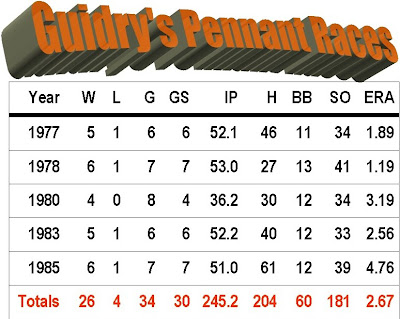 Is there really anything else to be said? I could recount the back-to-back two-hit shutouts of the Red Sox in '78. I could of course do an entire post on Guidry's victory in the one-game playoff at Fenway in '78, which many consider the greatest game ever played.
 And of course the post-season meant more of the same from Guidry: 5-2 with a 3.02 ERA in ten starts (eight of which the Yankees won). In the World Series Guidry was even better: 3-1 in four starts with a 1.69 ERA. Of his four WS starts, two were complete games. He pitched seven innings or more in each start and surrendered two runs or less in each.
We'll compare Guidry's extraordinary September and October success with some of the other great pitchers of the last 50 years, including certain pitchers with "big game" reputations who experienced considerable difficulties in September in the midst of pennant races.
The Best Big Game Pitcher Of His Generation

I know, it's a bold statement. If you're a big-league pitcher, there is not a more coveted title or reputation. It is the central argument for Curt Schilling's case for the Hall of Fame. It is no small part of Jack Morris's case for the Hall. It is a perfectly appropriate factor to consider in measuring the qualifications of a pitcher for the Hall.
I fear however that the sportswriters who vote for the Hall of Fame have overlooked Guidry's record as a big game pitcher, and have forgotten that big games take place not only in October but in September as well, when pennants and division championships are won and lost. And it turns out that success in October is not always joined with success in the heat of pennant races. There are pitchers with great post-season accomplishments who stumbled in the heat of pennant races, and others who consistently elevated their performance in pennant races but stumbled in October. And then there are pitchers like Ron Guidry, who were great in both months and seemed to rise to the occasion whenever the stakes were highest.
Ron Guidry participated in five pennant races with the Yankees between 1977 and 1985 where a spot in the post-season hung in the balance (there was nothing at stake for the Yankees in September in the strike interrupted '81 season because they already had a playoff spot locked up by virtue of leading the division when the strike occurred in mid-June)*. I've defined a "pennant race" as any season in which (i) a team was within five games of first place (or a wild-card spot) at some point in September prior to mathematical elimination, and/or (ii) were leading the division (or wild card race) at some point in September but with a lead of five games or less, and (iii) the pitcher at issue made at least one start when the race was within 5 games.
As any baseball fan can tell you, these September games are big when your team is in the race and time is running short. Sometimes they can even feel as big or bigger than post-season games. Guidry's record during these five pennant races was quite simply astounding. Only one other pitcher during the post-WW II era can arguably claim equivalence. This consistent and amazing success in tight pennant races is perhaps the most compelling argument for Guidry's inclusion in the Hall, relatively brief career notwithstanding. Let's look at the record.
Ron Guidry made 30 starts in September during these pennant races. He won 26 of them.
Let me repeat that: Ron Guidry won 26 of 30 September starts in the five pennant races in which he participated. That's not 26 of 30 DECISIONS (although Guidry was 26-4 in those 30 starts), and I don't mean that the YANKEES won 26 of the 30 games Guidry started. I mean that Ron Guidry was the winning pitcher in 26 of the 30 starts he made in September in the midst of tight pennant races.
Let's put that in some perspective. Only two pitchers in the last 50 plus years have even approached 26 wins in 30 starts during the course of a regular season: Denny McClain in 1968 and Bob Welch in 1990. McClain had a stretch of 26 wins in 32 starts (and 31 in 38) during his historic 31 win season in 1968. Welch had a stretch of 26 wins over the the last 31 starts of his historic 27 win season for the A's in 1990. In other words, take a pitcher on his way to a dream season of historic success, in which he'll win more games in a season than anyone has in decades, put a hard hitting team on its way to a World Series championship behind him, and you may get something close to 26 wins in 30 starts.
Let's put it another way. Koufax never came close in any comparable stretch of consecutive starts, either in a single season or across seasons. Gibson's best streak in his incredible '68 season: 19 in 24. Pedro's best: 21 wins in 26 starts during his 23-4 season in 1999. Guidry won 23 of 30 starts during the hottest stretch of his great 1978 season. Clemens had a stretch of 21 games in 1985 before experiencing his 5th loss or no-decision. Ford won 16 of 20 starts in 1961. Gooden's longest stretch without more than 4 non-wins in his 24-4 season of 1985 was 18 starts.
None of this is to say that the September Guidry was better than Koufax or Gibson or these other great pitchers. Rather, it is to illustrate the sheer improbability of anyone winning 26 of 30 starts under any set of circumstances. In a game where a fatefully placed pebble can turn the course of a World Series, as it did in 1960, events outside the control of any pitcher can serve to frustrate the efforts of even the greatest. And yet in 30 starts across five Septembers even chance could rarely thwart Ron Guidry.
We'll look at Guidry's glorious Septembers in the next post, and compare his record in the crucible of September pennant races to the records of the other great pitchers of the last 50 years. I hope that the Veterans Committee of the Hall of Fame will agree that Guidry's pennant race indomitability puts to rest any question of his qualifications for the Hall.
Here is the game log of Gator's 30 September starts in the years the Yankees were contending for the A.L. East title:
_________________
* Guidry also participated in the '88 race in the A.L. East, making the last five starts of his career, going 1-1 with a 5.18 ERA. The analyses to follow will focus on September performance in pennant races during which the pitchers were arguably in their prime, and will exclude past-their-prime Septembers unless their performance was exceptional. So, for example, Randy Johnson's September 2007 with Arizona and Tom Seaver's September 1986 with Boston are not reflected in their September statistics.

