The Guidry Decade

I've noted before the fact that Ron Guidry is the only pitcher in baseball history to lead the major leagues in wins and lead his own league in ERA and SO over a ten-year period and yet be rejected by the Hall. He averaged nearly 17 wins per season in the decade between '77 and '86 and had a 3.23 ERA (121 ERA+). When apprised of Guidry's achievement, my fellow baseball fans have had remarkably similar reactions, initially expressing some surprise at Guidry's accomplishment but then arguing that Guidry's statistics during this period, while impressive, were pre-eminent during this period only because this decade happened to occur at an odd interregnum in baseball, when greats like Seaver, Palmer and Carlton had just passed their prime and before the rise of Clemens, Maddux, Johnson and Martinez. They suggest that Guidry's performance really wouldn't have been that exceptional in any other era in baseball.
I must admit that I was inclined to give some credence to this argument. I assumed the win total wouldn't be that impressive when compared to all the titans who pitched during the eras of four-man rotations that prevailed in baseball until the '80s. I believed it was probably true that averaging about 17 wins a season over a decade while posting an ERA+ of 120 or greater was not all that unusual during many other eras in modern baseball history, and so I decided to check the record book. It turns out I was wrong. Averaging nearly 17 wins a season over a decade while compiling an ERA 20% better than the park-adjusted ERAs of your contemporaries has always been an achievement only the greats have attained. It turns out that this level of excellence over a decade gives a pitcher an almost automatic entree into Cooperstown. By my count, there have been 27 pitchers who accomplished this since 1920. All but four have already been inducted into the Hall of Fame or are almost certain to be inducted upon eligibility. And it further turns out that Guidry's accomplishment is becoming exceedingly rare in the age of the five-man rotation and seven inning starts.
The last pitcher to average as many wins as Guidry did over a decade was Randy Johnson from '97 to '06. Maddux came very close during the same period but finished a win shy of equaling Guidry's 16.9 wins per season. Maddux averaged 16.9 or more wins per decade from '95 to '04 and for each of the preceding seven ten-year periods* (i.e., every ten-year period commencing between 1988 and 1994). Since Guidry, only five pitchers have averaged 16.9 wins or more per season over a ten-year period while compiling an ERA+ of 120 or better: Maddux, Johnson, Clemens, Glavine and Mussina. Only two pitchers currently pitching have a realistic chance at accomplishing the feat any time in the next four years - Halladay and Santana. Halladay needs to win 39 games in the next two seasons to do it. Santana can do it by winning 70 games over the next four years. Although each as a realistic chance, the odds are long. (For the most recent ten-year period - 2000 to 2009 - Andy Pettitte led all major league pitchers with 148 wins.)
Guidry's statistical accomplishments between '77 and '86 were relatively rare even in the day of the four-man rotation, at least in the American League. Just as only Clemens and Mussina matched Guidry's feat in the AL over the 25 years since Guidry did it, only three American League pitchers accomplished the feat in the 30 years before Guidry. Bob Lemon did it for each of the ten-year periods concluding in '55, '56 and '57, averaging 19.7 wins per season with a 122 ERA+ during his best ten-year stretch. Whitey Ford did it for each of the ten-year periods concluding in '63, '64 and '65, averaging 17.3 wins with a 136 ERA+ during his best ten-year stretch. And Jim Palmer did it for each of the ten-year periods ending in '77, '78, '79, '80, '81 and '82, averaging 19.2 wins and a 139 ERA+ from '70 to '79.
In the history of the American League since 1920, only ten pitchers have averaged 16.9 wins per season and a 120 ERA+ over a ten-year span: Grove, Ferrell, Feller, Newhouser, Lemon, Ford, Palmer, Guidry, Clemens and Mussina. Only four other pitchers have averaged 16.9 wins per season in the AL since 1920: Hunter, Morris, Lolich and Wynn. There have been only two ten-year periods in the American League in which as many as two pitchers have accomplished this: Grove and Ferrell from '28 to '37 and Grove and Ruffing from '31 to '40. Feller and Newhouser would have done it within the same ten-year period if Feller hadn't lose four years to military service. In other words, had Guidry's magnificent decade occurred at any other time in AL history since 1920 he would have been one of only three pitchers at most to accomplish this feat in that ten-year period.
There was only one brief era in modern baseball history - the late '60s to late '70s - when there were more than three pitchers in any ten-year period to average 16.9 wins per season while maintaining a 120 or better ERA+. There were five pitchers to accomplish the feat in the decade from '69 to '78: Jenkins, Perry, Palmer, Carlton and Seaver. There were four pitchers in each of the decade periods of '68 to '77 and '71 to '80, and it was the same four pitchers for each period: Perry, Palmer, Carlton and Seaver.
In other words, Guidry's statistical accomplishments from '77 to '86 would have placed him among the very top echelon of elite pitchers in any era, generally accompanied by only one or two other pitchers in averaging nearly 17 wins per season and a 120 ERA+.

Besides Guidry, there are three other pitchers on this list who failed to make the Hall of Fame. Two of them, Wes Ferrell and Lon Warneke, had their peak years in the '30s. The other, Bucky Walters, had his peak years in the late '30s and during the war years. They had remarkably similar careers, each winning between 192 and 198 games and compiling ERA+s between 115 and 119. Each won between 170 and 175 games during their peak decade, meaning that for each pitcher his peak decade comprised substantially his entire productive career. Of the three, Walters was the only one to receive more than token support among HOF voters, twice topping 20% in the balloting in the mid-60s.

I generally agree with Bill's analysis (although I think he sells Ferrell a little short). I would make another point, however. While each of Walters, Ferrell and Warneke was among the leading winners in baseball during his peak decade, their ten-year win totals (175 for Ferrell and Warneke; 170 for Walters) were not particularly notable for the period. Certain of their contemporaries, as well as premier pitchers in succeeding decades, far exceeded their 10-year win totals, with Grove, Hubbell, Spahn, Marichal, Feller, Roberts, Lemon and Jenkins all averaging approximately 20 wins per season or more. Guidry's ten-year total, by contrast, ranks with the very best ten-year win totals during the era of the five-man rotation. Since Guidry's ten-year peak, only Maddux, Glavine and Johnson have eclipsed Guidry's tally by as much as one victory per season, and only Maddux's best 10-year stretch ('92 to '01) topped Guidry's total by two victories per season.
Guidry won almost as many games in a decade as did Ferrell, Warneke and Walters, despite pitching in an era where the five-man rotation and sharp decline in complete games have rendered the 17-win season the functional equivalent of the 20-win gold standard of prior eras. That fact alone would seem to distinguish Guidry from the three other pitchers who have failed to make the Hall despite a decade of averaging 17 wins per season and a 120 or better ERA+, and would seem to dictate that he join the 23 other pitchers who have accomplished this feat and are either already in the Hall or on a glide path to Cooperstown.

Don Sutton, 164 wins, 120 ERA+
Nolan Ryan, 160 wins, 116 ERA+
Early Wynn, 188 wins, 116 ERA+
Lefty Gomez, 160 wins, 127 ERA+
Waite Hoyt, 166 wins, 114 ERA+
Eppa Rixey, 166 wins, 119 ERA+
Herb Pennock, 163 wins, 116 ERA+
Catfish Hunter, 184 wins, 111 ERA+
Let's begin by taking two very striking examples: Early Wynn and Don Sutton, each of whom had very long careers and joined the cherished 300 win club.
Wynn's peak decade was '50 to '59, during which he won 188 games and had a 116 ERA+. On either side of the that peak decade Wynn was 83-94 with a 92 ERA+ ('39 to '49) and 29-31 with a 105 ERA+ ('60 to '63). Outside of his peak decade, Wynn had two seasons where he won more than 13 games: 1943, when he went 18-12 with a 110 ERA+, and 1947, when he went 17-15 with a 103 ERA+. Neither season was the equal of his average season during his peak decade.
Sutton's peak decade was '71 to '80, in which he won 164 games with a 120 ERA+. On either side of that peak Sutton was 66-73 with a 95 ERA+ ('66 to '70) and 94-81 with a 102 ERA+. Like Wynn, Sutton didn't have a single season outside his decade peak where his W-L record and ERA approached his average season during his peak. Like Wynn, he didn't have a single season outside of his peak that, if replicated over a 10 or 12 season period, would have given him a credible argument for the HOF.

Carl Hubbell had a ten-year peak very similar to Gibson's where he was a consistently big winner with superlative ERAs. Outside that peak decade he didn't have a single season where he won more than 11 games.
 The following HOF or presumptive HOF pitchers didn't have a single season outside their ten-year peak in which they won 15 games and had a 112 or better ERA+: Drysdale, Lemon, Newhouser, Marichal, Wynn, Ruffing, Roberts, Vance, Hubbell, Sutton, Gomez, Hunter, Feller, Coveleski, Pedro Martinez and Curt Schilling. The following pitchers had exactly one such season outside their peak decade: Bunning, Jenkins, Palmer, Gibson, Ryan, Hoyt and Randy Johnson.
The fact is that most HOF pitchers were truly great for a period of about ten years. Pitchers like Walter Johnson, Maddux, Spahn, Clemens and Seaver who had multiple outstanding seasons outside their peak decade are the exception, not the rule. It is clear that Ron Guidry had a peak decade that is comparable to the peak decades of many Hall of Famers - Bunning, Drysdale, Lemon, Wynn, Sutton, Gomez, Hunter, Jenkins, Ruffing and Roberts, among others. It is also clear that none of these pitchers did anything outside of their peak decade that materially added to their HOF qualifications.
I would humbly submit that by any statistical measure Guidry's HOF qualifications are the equal of Bunning's, Dyrsdale's, Lemon's, Newhouser's, Vance's and Gomez's. To the extent they won more games in their career it is because they pitched in the era of four-man rotations. I would also submit that Guidry's HOF qualifications are the equal of Ruffing's, Hunter's, Sutton's and Niekro's. To the extent they won more games than Guidry they did so primarily because they had many more seasons where they were perhaps competent major league pitchers but not HOF quality pitchers.
There will no doubt be those who argue that many of these pitchers don't meet their particular idea of HOFers. Hunter, Bunning and Drysdale are examples of more recent HOF inductees who are frequently characterized as marginal inductees. Vance, Newhouser, Coveleski, Pennock, Hoyt and Faber are just a few examples of other pitchers who have been deemed by many to be marginal HOFers. I think it is fair to say that Guidry's HOF qualifications stack up pretty well against the qualifications of all the pitchers I've named in this paragraph. If one wants to argue nonetheless that Guidry doesn't belong in the Hall then they are in effect arguing for a much smaller Hall of Fame and for HOF standards that are radically more restrictive than the standards that have been observed for the last 75 years.
P.S. Here's a list of pitchers who just missed making the 17 wins/120 ERA+ list, either because they had too few wins, an ERA+ less than 120 or because some of their peak seasons occurred prior to 1920.
______________________________
* Win totals for any pitcher who pitched during strike-shortened '81, '94 and '95 seasons have been adjusted to reflect shortened seasons. For example, Maddux's win totals for any decade that includes both the '94 an '95 seasons was divided by 9.6 rather than 10 because approximately 40% of a season was lost between the premature end to the '94 season and the belated start of the '95 season.
The Sheer Improbability
My last post on pitchers who won two-thirds of their starts in a season got me to thinking again about Gator's amazing record in September division title races. I noted Lefty Grove's incredible '31 season in which he won 27 of 30 starts, a feat unmatched in baseball history. I noted that Bob Welch won a higher percentage of his starts in 1990 than any pitcher since 1954, and he won only 24 games during his best 30-start stretch.
I've noted before the sheer improbability of winning 26 of any 30 starts selected on the basis of any unbiased criterion. It's highly improbable that a pitcher would win 26 of 30 weekend starts, or starts in day games at home, or starts against teams in your own division. But to get an even clearer idea of how difficult it is to win 26 of any 30 starts, even 30 starts selected by a manifestly biased criteria, consider the following.
 Let's make the criterion games in which a great Hall of Fame pitcher received 11 or more runs of support in a start, a very biased criteria because tremendous run support will skew the results toward an extraordinarily high percentage of starts won. Steve Carlton made 32 starts in his career in which he was lavished with 11 or more runs of support. He won 27 of those games, or a slightly lower percentage than Guidry's percentage of wins/start in September pennant races. Don Sutton got 11+ runs of support in 25 starts and won 20. Phil Niekro won 16 of his 21 starts in which he received 11+ runs. Fergie Jenkins had the best record in this category of the pitchers I examined, winning 20 of his 22 starts where he received 11+ runs. All in all, these four Hall of Fame pitchers started exactly 100 games in which they received 11+ runs of support and they won 83. You don't need your calculator to determine that works out to 83%. Ron Guidry won 86.7% of his September starts in division title races.
That's how difficult it is to win 26 of 30 major league starts under even the best of circumstances. Take a Hall of Fame pitcher, give him the run support of his dreams, and he still won't win 26 of 30 starts.
I'll be turning back to Guidry's big-game record in future posts because it is, I believe, the crux of his case for the Hall of Fame, if for no other reason than that most fans, sportswriters and HOF voters are probably unaware of this record. Guidry for some reason isn't associated with the term "big game pitcher" in the same way that various other pitchers are. If you ask most knowledgeable baseball observers to name a big-game pitcher from the '70s and '80s they'll mention Jim Palmer, Tom Seaver, Jack Morris or Luis Tiant. Each of those pitchers was indeed a great big-game pitcher, but Guidry was even better. I think the Veterans Committee of the Hall of Fame should be aware that Guidry was the best big-game pitcher of his generation. It might not be enough to put him over the top, but I think we can all agree that a pitcher's big-game performances are an important qualification for the Hall. It certainly helped put Catfish Hunter in the Hall. It was unquestionably the reason why Bob Gibson was a first-ballot inductee in 1981 and Juan Marichal wasn't. And when Curt Schilling makes the Hall, as he almost certainly will, it will be in no small measure a result of his spectacular big-game record in October.
I obviously believe, with passion and conviction, that Gator belongs in the Hall. If the Veterans Committee disagrees, if they believe his career was too short, or his peak too brief, I'll disagree but I'll respect their judgment. But if the Veterans Committee denies Gator and are unaware that he was one of the greatest big-game pitchers in baseball history, that would be a shame.
Start The Game, Win The Game
Trivia question: since 1920 there have been only two pitchers to win two-thirds or more of their starts in a season more than twice (minimum 30 starts). Who are they? While you think about that I'll give you some idea of how special this achievement is.
Since 1954 a pitcher has started 30 or more games in a major league season more than 3000 times. Only 30 times has a pitcher started 30 or more games and won two-thirds of his starts. That's less than 1% of the 30-start seasons since 1954.
Since 1954 only four pitchers have accomplished this feat more than once. Can you name them? Here are some hints. Sandy Koufax never did it, narrowly missing in '66. Greg Maddux never did it, either, although he came close in '95 when he won 19 of 29 starts. Whitey Ford came close in '56 and '63, but never did it. Steve Carlton never did it, although he won 27 of his 41 starts in '72.

Here are three of the four post-1954 pitchers who did it more than once: Roger Clemens did it twice, in '86 and '90. Juan Marichal did it twice, in '66 and '68. Pedro Martinez did it in '02 and would have done it '99, when he won 22 of his 29 starts. Let's give Pedro credit for that season, however, because he would have done it even if he hadn't won that 30th start.

Bob Welch won an extraordinary 77.1% of his starts in 1990. The only other pitcher to have started 30 or more games in a season and won 75% or more of them is Denny McLain in his great '68 season when he won 75.6%. Pedro won 75.9% of his 29 starts in '99. The only other pitchers to have topped the 70% mark are Clemens in '86 (72.7%), Seaver in '69 and Guidry in '78 (71.4%), and Cliff Lee in '08 (71.0%). Dave McNally won precisely 70% of his starts in '71.
The only pitchers since '54 to turn the trick while winning 25 or more games are McLain, Welch, Marichal, Seaver, Guidry, Newcombe and Stone.
Doc Gooden, of course, was the youngest pitcher to turn the trick - 20 years old. Warren Spahn, of course, was the oldest - 42 years old.

Here are some more pre-1954 seasons where pitchers won two-thirds of their starts:
Warren Spahn. In addition to his great '63 season, Spahnie won 23 of his 32 starts in 1953, making him one of the very select club of pitchers two have accomplished the feat more than once.
Hal Newhouser. Prince Hal won 2/3s of his starts in '45 and '46. He almost certainly did it in '44 as well, but splits aren't available for that year. However, unless Hal won 6 of his 13 relief appearances that year (very unlikely) he also won 2/3s of his starts in '44.
Bob Feller. Rapid Robert accomplished the feat twice, in '40 and '51. He also narrowly missed in '39, winning 23 of his 35 starts.
Carl Hubbell. King Carl won 24 of his 34 starts in his great '36 season.
Dizzy Dean. The Diz won 26 of his 33 starts in his great '34 season. He won 24 of 36 the next year.

Bucky Walters. Bucky won 27 of his 36 starts in '39. He won 2/3s of his starts in '44, too.
Dazzy Vance. Dazzy did it in '24 and '25. Dazzy joins Lefty, Dizzy and Hal Newhouser as the only pitchers to accomplish the feat in consecutive seasons.
Paul Derringer. Oom Paul did it in '39, the same year his teammate Bucky Walters turned the trick. They are the only teammate tandem to ever accomplish the feat.
Lefty Gomez. Lefty won 2/3s of his starts in '32 and '34.
Bob Lemon. Bob won 22 of 33 starts in '54.
That's not a comprehensive pre-1954 list, but it demonstrates how difficult it was for even great pitchers to win 2/3s of their starts in a season.
Here is the full list since 1954, including Pedro's '99 season in which he made only 29 starts:

_________________________
* As noted above, Hal Newhouser might have done it, too, but the game logs for 1944 aren't available. However, even if Hal did it three times, two of those times would have occurred during the depleted WWII years.
Did You Know...
There are eleven pitchers since 1954 who won at least 50% of their starts. Here they are:

Seaver, 47.9%
Maddux, 47.9%
Morris, 47.6%
Schilling 47.2%
Gooden, 47.1%
Hunter, 46.6%
Carlton, 46.1%
Tiant, 45.2%
Glavine, 44.7%
UPDATE: As of May 1, 2010, here are the top 100 pitchers in terms of percentage of stars won since 1952 (clicking on the preceding link will take you to the spreadsheet at Google Docs):
Welcome To The Club, Bill

In this chapter, Bill returns to one of his favorite subjects: Hall of Fame standards for starting pitchers. He's noted many times in the past that Hall of Fame voting in recent years appears to reflect a movement away from traditional HOF standards for starting pitchers toward an emphasis on longer careers and the accumulation of huge career statistics (high career win totals, strikeouts, etc.). If it were up to today's HOF voters would pitchers like Drysdale, Lemon, Newhouser, Bunning, Hunter, Gomez and Dean be in the Hall of Fame? It's not at all clear.
Bill introduces a system based on something called "Season Scores"* that awards points to a pitcher for ranking among the top starting pitchers in the league and awards bonus points for a particularly dominant season: for ranking as the top pitcher in the league, leading the league in Season Score by 50 points or more, and compiling a historically high Season Score. A pitcher can accumulate a maximum of 9 bonus points, three for each of the three achievements listed in the preceding sentence. Bill identified twelve seasons since 1930 in which a pitcher earned the maximum 9 bonus points. Oddly, this hasn't been achieved since Doc Gooden's 1985 season; not Pedro, not Randy, not Roger, not Greg. Here are the twelve seasons:
Grove, '30 and '31
Hubbell, '33
Dean, '34
Roberts, '52
Koufax, '63, '65, '66
McLain, '68
Carlton, '72
Guidry, '78
Gooden, '85
The method for calculating Seasons Scores and then cumulating to arrive at a career HOF-worthy point total is rather prosaic and so I won't go into the precise method here. It is notable less for sophisticated statistical analysis than for the high correlation between top Season Scores and the balloting that awards Cy Young's and HOF inductions. It is, in other awards, an insight into the approach the baseball writers have used, wittingly or unwittingly, in evaluating pitchers for the Hall and for Cy Young Awards. Bill found that his system very accurately predicts which pitchers make the Hall, at least among pitchers who retired prior to 1990; after that the system breaks down, in the sense that various pitchers who've accumulated enough career HOF-worthy point totals to have traditionally qualified for induction have failed to even merit serious consideration among HOF voters. Dwight Gooden and David Cone are two such examples.
Bill identifies only two pitchers who retired prior to 1990, accumulated career HOF-worthy point totals well in excess of the traditional requirement, and yet have failed to make the Hall. Bill calls these two the "true outliers" in the analysis. They are Bert Blyleven (of course) and Ron Guidry. As Bill puts it:
"Blyleven and Guidry are so far above the Hall of Fame line that one would think that their Hall of Fame selection would not be an issue. Blyleven, of course, has become a popular candidate. Guidry has not."

Bill returns to his "Guidry and Gomez" comparison that he's made before, most notably in his Historical Baseball Abstract. But whereas Bill formerly believed that Gomez was a marginal HOF inductee, and Guidry a shade behind Gomez in his qualifications, he now believes that both are clear HOFers and that Guidry is actually more deserving.
"In the past, I have analyzed this comparison in this way:
1) Gomez was fortunate to make the Hall of Fame, being very marginally qualified,
2) Guidry was similar but a little bit behind Gomez, thus not in a range where his Hall of Fame selection was likely,
3) Gomez had three outstanding seasons; Guidry only one, 1978, and
4) Gomez made the Hall of Fame, in part, based on his post-career reputation as an entertainer and ambassador for the game.
But the implications of this new method are totally incompatible with that analysis. As this method sees it, putting Gomez in the Hall of Fame was not a reach. Gomez is well qualified based on the number of high-quality seasons that he produced. And Guidry, rather than ranking behind Gomez, in fact ranks far ahead of him."Bill then examines his rankings of Guidry among the league's best pitchers in various seasons and observes that "Guidry [had] four seasons among the league's four best pitchers, and he was competing in a 14-team league. Gomez had four such seasons, competing in an eight-team league."
Bill sums it up this way:
"By Guidry's era, career win totals had come to dominate the Hall of Fame discussion. Perhaps this is right; perhaps it is wrong. I am not suggesting that my new method here should substitute for all other judgments about Hall of Fame selections, not at all. There are many other ways to look at the issue. Perhaps those other ways are better.
But while those other pitchers have 100+ wins more than Guidry, Guidry's winning percentage was far better than Carlton's, or Sutton's, or Niekro's, or Kaat's, or Tommy John's, or Ryan's, or Blyleven's or Gaylord Perry's; it was even far better than Tom Seaver's. Guidry was further over .500 - wins minus losses - than most of those pitchers.
Steve Carlton's ERA was 41 points better than the league norm for this career. Don Sutton's ERA was 45 points better-than-league, Tommy John's was 42 points better, Blyleven's 50 points better. Jim Kaat was 15 points better than league. Ron Guidry's ERA was 76 points better than the league average.
I am merely pointing this out: in general, through baseball history, pitchers who have this many seasons as one of the best pitchers in their league have been almost automatic Hall of Fame selections. Historically, the Hall of Fame has made room for all pitchers with 250+ wins, but also for pitchers who were more dominant in shorter careers."Well put, Bill. Your analysis is already driving some of the stat geeks crazy, but your point is nonetheless valid. Ron Guidry does indeed belong in the Hall of Fame. Even forgetting many of the aspects of Guidry's career I've discussed in this blog, Ron still qualifies for the Hall based on the standards employed by the HOF in the first 60 years of HOF balloting. Throw in the fact that he was the best big-game pitcher of his generation and it's a no-brainer.
I know Bill will insist he wasn't campaigning for Ron's induction, but I'm inviting him into the "Put Gator In The Hall" club anyway.
"But If You Put Guidry In The Hall...

...then don't you have to also induct [fill in the blank]?" I believe the name cited most frequently to fill in that blank is Dwight Gooden. It's true that the similarities between Gator and Doc are striking, so let's compare and contrast.
Any discussion of Dwight Gooden has to begin with the acknowledgment that he was the greatest pitching phenom in major league history. Only Feller comes close to Gooden's achievements before reaching the age of 21. He finished 2nd in Cy Young voting in his rookie year, shattering the record for most strikeouts per nine innings by more than two-thirds of a strikeout. He then had one of the greatest seasons ever in his sophomore year. He was Dr. K, and he was the biggest star in the game at the age of 20. There was talk that we might be witnessing the greatest pitcher in the history of the game. It didn't turn out that way.
The parallels between Guidry and Gooden are many. Both were absolute sensations in their first two full years; no pitcher has ever had a better two-year start than Guidry and Gooden. Each produced one of the greatest pitching seasons in history in his second year, winning the Cy Young Award unanimously. Neither again achieved the dominance he displayed in his second season, but each nonetheless proceeded to compile by far the highest winning percentage of any starting pitcher in his league over the next seven seasons. Each was a figurative runaway freight train down the stretch in pennant races in their first two full seasons. Each maintained a winning percentage over the first 200 decisions of his career approaching .700.
The similarities don't stop there.
A year-by-year approach I believe is a simple way to compare careers in more detail and depth than merely examining career totals. The following Guidry v. Gooden demonstration reveals striking similarities in the arcs of their respective careers.

Again, the similarity in their careers is striking. There's not much to choose from in a comparison of their first four full seasons. And the statistical similarity continued for the balance of the respective productive careers. The following are Guidry's career totals and Gooden's totals through 1996 (the last season Gooden would pitch enough innings to qualify for the ERA title):

Almost identical, save for a meaningful, but not huge, edge for Guidry in the ERA+ number. Here's the difference, however. After Dwight's first four seasons he never really put together a season that clearly qualified him as one of the premier pitchers in his league. Despite putting up consistently good winning percentages for good Met teams, Gooden's ERAs and other statistical achievements were notably mediocre. Consider the following:
Guidry, by contrast, added three more seasons over the latter half of his productive career in which he had both impressive win totals and an ERA+ significantly better than the average: '81, '83 and '85. He had two more 20 win seasons and two more seasons in which his ERA+ was at least 20% better than league average.
The simple fact is that Doc was never really a premier pitcher in the NL after his first three years. And as great as those three years were, three great years have never put anyone in the HOF. Guidry's first three years were also monumental, but he added three more years in '81, '83 and '85 when he was unquestionably one of the top pitchers in the AL, and was the lefthanded starter on the Sporting News annual all-star teams.
Throw in the big disparity in post-season performances and Guidry's edge over Gooden becomes decisive.
Quite simply, you can put Guidry in the Hall and leave Doc out, and no one could complain too much about Doc being done an injustice.
Pick Five
Here are the averages of the best five seasons of various great pitchers. Each of the anonymous pitchers are already in the Hall or, if I don't miss my guess, will be. See if you can determine who they are based on their wins, losses, winning percentage and ERAs. The ERA figures in the following table are the product of their ERA+ and an assumed league average ERA of 4.00.

Here are the identities of these pitching greats:

Guidry's best five seasons (using either the '81 or '83 season as the fifth) compare favorably with the best five seasons of these other great pitchers. Koufax's ERA and winning percentage obviously stand out. Feller and Hubbell were each very big winners, averaging 23 and 24.4 wins respectively in their best years (Koufax would have averaged more wins per year had he not missed two months of the '62 season and the last six weeks of the '64 season). Gomez's best five seasons include two pitching triple crown seasons, but Guidry's numbers still compare quite well. Hubbell's best five include three ERA titles, but Guidry's ERA, particularly if one includes the '81 season, is virtually the same as Hubbell's.
Just to give some sense of how spectacular the peak seasons of these pitchers are, there are seven pitching triple crown seasons among them - three for Koufax, two for Gomez and one each for Hubbell and Feller. Each of the pitchers listed averaged a 140 or better ERA+ over their best five seasons, with Koufax leading the way with a 167 ERA+ (Gibson was second in this group with a 152 ERA+). The lowest winning percentage in the group was Gibson's .667; Koufax and Guidry both maintained an incredible winning percentage over .750 over their five best seasons.
There were a few small surprises for me in these numbers and one big one. The small surprises included Schilling's excellent winning percentage (.731) and Feller's excellent ERA (I was, for some reason, unaware of how good Feller's ERA+'s were in his prime years). The big surprise was that Guidry won a higher percentage of his starts in his best five than Koufax; Guidry won an astounding 64% of his starts to Koufax's 63%.
Did You Know That Ron Guidry...
...is the only pitcher to have won a Cy Young and received CY votes in five other seasons and be rejected by the Hall?
There have been twelve pitchers to do this and other than Ron Guidry each is already in the Hall or, barring unforeseen circumstances, will be a first ballot HOFer. The twelve are Tom Seaver, Jim Palmer, Ferguson Jenkins, Steve Carlton, Ron Guidry, Dennis Eckersley, Roger Clemens, Randy Johnson, Greg Maddux, Pedro Martinez, Tom Glavine and Johan Santana.

That makes 15 pitchers who have received Cy Young support in six different seasons, and every one received (or will receive) more than 40% support for the Hall of Fame, except one. You know his name. I'll remind you that he never even received 9% of the vote.
Incomprehensible. Really, just inexplicable.
P.S. Another interesting Cy Young fact: Guidry's six seasons in which he received CY votes happened within a nine year span. Randy Johnson took only eight years to accumulate six such seasons. Carlton, Glavine, Jenkins, Eckersley, Ryan and Morris each took more than nine years to accomplish the feat.
Guidry v. Schilling
I'm ambivalent about Schilling's qualifications for the Hall, but let's face it - he's going in. His big game reputation and outstanding post-season record will put him over the top.
Schilling Shills generally acknowledge that his record is very erratic, his inconsistency and periodic arm issues resulting in numerous single-digit win totals and poor winning percentages throughout his career. The Shills fairly argue, however, that Schilling's peak years were excellent and deserving of HOF induction. Let's compare Schilling's peak years to Guidry's, doing a year-by-year comparison.
The following table lists Schilling's and Guidry's peak years in descending order of wins.

I've inserted a "G" or "S" in the middle column to indicate which pitcher, in my opinion, had the superior year. Here's my reasoning for each year.
Year One, Guidry's '78 v. Schilling's '02. Amazing year for both. A clear and significant edge for Guidry, however, on the basis of his historic record and ERA, the amazing September and post-season performance, and the fact that Guidry's season was the key to the Yanks' comeback, the biggest in AL history.
Year Two, Guidry's '85 v. Schilling's '01. The same record for each, but Schilling's great October and excellent ERA give him the decision.
Year Three, Guidry's '83 v. Schilling's '04. Another win for Schilling. Better record, better ERA, plus a good October for Curt.
Year Four, Guidry's '79 v. Schilling's '97. Similar records and ERA+'s, but slight edges to Guidry in each case. Also, Guidry won the ERA title.
Year Five, Guidry's '80 v. Schilling's '93: Good records but mediocre ERAs for each. I thought about giving the nod to Schilling on the basis of his good Sept/Oct for the Phils. Guidry also had a good September, however, and has the superior ERA+, so he gets the edge.
Year Six, Guidry's '77 v. Schilling's 2006. Similar records, but Guidry's superior ERA+ and tremendous Sept/Oct performance during the Yanks' championship season give Guidry the clear win.
Year Seven, Guidry's '82 v. Schilling's '99. Schilling has the superior record and ERA, so a clear win for Curt.
Year Eight, Guidry's '81 v. Schilling's '98: An odd comparison because Guidry's season is the strike-shortened '81 season. Schilling has a very slight edge in ERA+, but Guidry's clearly superior record, selection as Sporting News' lefthanded starter for the A.L. and impressive World Series performance gives him the clear edge.
Year Nine, Guidry's '84 v. Schilling's '92: Easy win for Curt; Guidry's only season where arm injury was a significant factor.
Year Ten: Slight edge for Schilling, but this season and all other seasons for each not reflected in this table don't really qualify as "peak seasons."
It's split, five seasons for each, but Guidry takes four of the top six. The point here, however, is not to make some fine distinction between Schilling and Guidry, but to demonstrate how close the two are. The "big game" comparison doesn't really resolve anything, either: both have very similar World Series records, Schilling has the overall post-season edge, but Guidry has a huge edge over Schilling in pennant race performances.
I would ask all the BBWAA voters who will vote for Schilling to explain how the BBWAA as a group could find no more than about 9% of the vote for Guidry. Isn't it apparent that over their peak years they were very similar? Isn't it also apparent that Schilling's "non-peak" years (more numerous than Guidry's, who played only a few years after his peak ended) are not a plus in his HOF resume? Here they are:

This number of mediocre records and short seasons are actually a negative, from my point of view, and when the BBWAA considered Bret Saberhagen for the Hall they apparently felt the same way - good pitcher, too many poor or abbreviated seasons.
Guidry has the edge over Schilling in my book because he was a more consistent winner, had the distinctly superior record down the stretch in pennant races, and never stumbled in a pennant race. Schilling was great in October, but uneven in September, and he played a significant role in tanking the D'backs shot at one division title and almost losing another.
I don't know if Schilling belongs in the Hall of Fame, but I'm pretty damn sure he's going in. I'm also sure of one other thing: if Schilling goes into the Hall, Guidry belongs there, too.
The Thin Man
 The following is the opening paragraph from an article on Guidry in Sports Illustrated's September 19, 1977 edition entitled "Getting Fat With The Thin Man," a reference to the slender Louisianan's emergence as the Yankee ace as the team surged past the Red Sox and Orioles to win the AL East title.
Guidry's epic performance during the '78 pennant - the win in the one-game playoff at Fenway, the back-to-back two-hit shutouts of the Sox in September - didn't come as a surprise in Yankee fans. In fact, it seemed very familiar, because Guidry had been almost as dominant during the Yanks' 41-13 charge down the stretch in '77. It's likely Guidry's '77 performance would occupy a more significant place in baseball lore but for the shadow cast by the legendary '78 season."From Aug. 7 through the end of last week, the Yankees won 28 of 34 games and moved from third place, five games out, to two ahead in the American League East...And when a team goes on a tear, there invariably is a starting pitcher high on the list of streakers. Because the Yanks' staff is loaded with the likes of World Series heroes Catfish Hunter, Don Gullett and Ken Holtzman, it is hardly surprising that New York found a hot arm. The astounding thing is that the limb is attached to the left shoulder of Ron Guidry, a pitcher whose reputation had been as puny as his 5'11", 158-pound body."
The Yankees lost four of their first five games in August '77 to drop five games behind the Red Sox and 2.5 games behind the Orioles. Don Gullet, the Yanks' prize free-agent signing of '77, was on the disabled list. Catfish Hunter, Mike Torrez and Ed Figueroa, the mainstays of the Yanks' staff in '76, were collectively 26-25. And Ron Guidry, a relief pitcher plucked from the bullpen by Billy Martin in mid-May to bolster the stumbling starting staff, had a decent if unspectacular record of 8-6 and a 3.25 ERA.
Torrez pitched a six-hitter on August 7th to break a three-game Yankee skid and begin a streak of 24 wins in 27 games that vaulted the Yankees past the Red Sox and Orioles into first place in the AL East. The Yankees remained hot the rest of the season, ultimately winning 41 of their last 54 games, equalling the '51 Giants' 54 game dash to the NL pennant in the Miracle of Coogan's Bluff. As Sports Illustrated noted, the Yankees' ace down the stretch was, improbably, the slightly built Louisianan who'd pitched only 54 innings in the major leagues before joining the Yankees starting staff.
El Tiante v. Louisiana Lightning
 Baseball Crank has an excellent evaluation of Blyleven, Morris, Kaat, John, Tiant, Guidry and others in a January 2001 post. It's a very detailed, incisive and fair assessment of the HOF qualifications of various pitchers, and I agree with his conclusions that Morris, John and Kaat fall short, if just barely. And I really applaud his support of Luis Tiant's induction, particularly his citation of Tiant's outstanding September records for the Red Sox in '70s pennant races. We differ on Blyleven, but Baseball Crank's evaluation of Blyleven is one of the few I've seen that candidly acknowledges the faults in Blyleven's HOF resume: the generally mediocre win totals and winning percentages even when pitching for solid teams.
I'll discuss on the next page Baseball Crank's discussions of Luis Tiant and Ron Guidry. I think Baseball Crank would agree that upon closer examination Guidry has many of the same qualifications as Tiant. I also think that Baseball Crank would agree (fair-minded fellow that he is) that in one instance he grossly mischaracterized Guidry's record.
The Crank begins by noting that Tiant posted particularly outstanding ERAs in '68 and '72:
"Consider: between 1921 and 1993, only three pitchers qualified for the ERA title with an ERA below 2.00 more than once: Sandy Koufax, Hal Newhouser, and Luis Tiant. Tiant's 1.91 mark in 1972 was the lowest at Fenway between Babe Ruth's 1916 season and Roger Clemens in 1990; his 1.60 ERA in 1968 remains the lowest in the AL since Walter Johnson in 1919. Those gaudy ERAs are less impressive when you consider that 1972 and 1968 were the low points for scoring in the AL after 1920, but the translated ERAs for the two seasons are still impressive, 1.99 and 2.16."As the Crank acknowledges, '68 and '72 were the two most pitching dominated years in modern American League history. Still, Tiant's ERAs were outstanding, translating to a 186 ERA+ in '68 and a 170 ERA+ in '72. There were only eight pitchers between 1921 and 1993 who posted more than one season with a 170 ERA+ or better: Lefty Grove, Lefty Gomez, Ted Lyons, Dazzy Vance, Whitey Ford, Sandy Koufax, Hal Newhouser and Tom Seaver. A trio of lefties - Spahn, Carlton and Hubbeel - narrowly missed achieving the feat.

The Crank then makes the following observation relative to his discussion of Tiant's outstanding ERAs in his best seasons:
"As the TR for Tiant indicates, he was a guy who would have been a winner even on average teams; his offenses, on balance, just weren’t that great."Sorry, Crank, but this is simply not correct. Tiant's offensive support during his years with Boston - the bulk of his HOF resume - was very, very good, if not great. In five of Tiant's seven full seasons with the Sox his run support ranged from .7 to 1.5 runs/game higher than the league average! Even adjusting for the Fenway factor, this is tremendous run support. Throw in the other two years, when his support from the Sox approximated the league average, and Tiant's run support from the Sox was approximately .7 runs/game higher than the league average over the period '72 to '78.
The Crank then compares Tiant's career statistics to the stats of eight HOF pitchers (including Bunning, Drysdale, Hunter and Newhouser) and draws the following conclusion:
"The best case for Tiant is that he meets the standard they don't: a guy who would still have had very good records even with just average teams. Yeah, Catfish won more games in the postseason, but tell me that Tiant wasn’t as good a big-game pitcher as anyone in his time; counting the postseason, Peter Gammons in “Beyond the Sixth Game” noted that Tiant’s September/October record with the Red Sox – in some of the tightest pennant races and series ever – was 32-10. 32-10!"It's not clear what Tiant would have done with "just average" teams, but it's very clear what he did with good teams because the Sox averaged more than 90 wins a season and compiled a cumulative .562 winning percentage from '72 to '78. It's true that the Cleveland teams Tiant pitched for in the '60s were generally mediocre, but the Crank would have to admit that Tiant didn't compile "very good records" with the Indians other than in '68. The Crank's suggestion that Tiant's teams weren't as good as those Drysdale and Hunter pitched is misleading; the Sox teams were very good and any edge the '60s Dodgers or '70s A's may have had was due to deeper pitching staffs and bullpens, because the '70s Sox teams were very good hitting teams.
One quibble with the September stats the Crank so astutely references: Tiant was 31-12 with Sox in September and October, not 32-10. However, I completely concur with the Crank's assertion that Tiant was one of the great big game pitchers of his time. Tiant's 31-12 Sept/Oct record with the Sox certainly deserves the exclamation point the Crank attaches. But if 31-12 deserves an exclamation point, then Guidry's pennant race record - 26 wins in 30 starts - deserves a fireworks display.
Here's the Crank's take on Guidry's HOF qualifications:
"...[W]ith him the question is simple: did he stay on the mountaintop long enough? Maybe it’s just a gut feeling at this point, but I say no. His ERAs and other numbers in 1983 and 1985 just don’t say “Dizzy Dean” or “Ed Walsh;” he was a very good pitcher with a very good offense in those years, but he wasn’t carrying the team on his back. That really just leaves a 3-year stretch (1977-79) when he dominated the league, and in two of those years he fell short of 20 wins. Guidry was only a slightly healthier version of Saberhagen or Gullett – great pitchers all when 100%, but rarely all in one piece. He's OUT."I'll offer brief rejoinders to the Crank's first two claims. First, Guidry stayed "on the mountaintop" at least as long as Tiant, and his mountaintop was higher. Tiant had arguably eight very good seasons (seven with the Sox and one with the Tribe) during which he was 142-83 (a .631 win%) with a 126 ERA+. Guidry's totals for his best eight years were 144-56 (a .720 win%) with a 129 ERA+. Here's the really startling fact, however: the Sox and Indian teams over those eight years had a .543 winning percentage when you subtract Tiant's records; Guidry's Yankee teams had a .552 winning percentage without his contribution. Simply put, Tiant's winning percentage relative to his teams was great, but Guidry's was astounding.
Second, as for Crank's contention that Guidry's ERAs in ' 83 in '85 "just don't say 'Dizzy Dean' or 'Ed Walsh'", I would respond simply that Guidry's ERAs in those two years compare quite favorably with Dean's ERAs (though neither compares with Walsh, who compiled the lowest career ERA in baseball history during an era when the game barely resembled the game Dean and Guidry played). The Crank cites the '83 and '85 seasons because Guidry had great W-L records in those years but comparatively pedestrian ERA+ of 113 and 123, respectively. Contrary to the Crank's claim, however, those ERAs say "Dizzy Dean" quite clearly - Dean had ERA+ of 124 and 114 in his 3rd and 4th best years (i.e., '36 and '33). I'd further point out that Dean's ERA+ of 159 and 135 in his two best seasons don't begin to compare with Guidry's peak years from '77 to '79. Dizzy Dean was a great pitcher, one who averaged nearly 27 wins per season in the 3 1/2 years preceding Earl Averill's line drive off Dean's toe in the '37 All-Star game, and he clearly belongs in the Hall in my opinion. But the Crank's unfavorable comparison of Guidry's ERAs to the Diz's is off target.
That brings me to my final rejoinder to the Crank's characterization of Guidry's HOF bona fides. The Crank calls Guidry a "slightly healthier version" of two famously injury-plagued pitchers, Don Gullett and Bret Saberhagen. The Crank couldn't be further off the mark with this one. In fact, I'm completely mystified by this claim because Guidry was virtually injury-free except for the '84 season. During Gullett's peak from '71 to '77 he average only 181 innings per season and failed to pitch enough innings to qualify for the ERA title in four of those seasons. Saberhagen averaged approximately 200 innings per season during his peak from '84 to '91 and failed to qualify for the ERA title in three of those years. Guidry, by comparison, averaged 230 innings during his peak from '77 to '85, pitching enough innings to qualify for the ERA title every year. Just to illustrate the absurdity of the Crank's characterization of Guidry, consider that the consensus "iron man" of the '80s, Jack Morris, averaged 262 innings per season from '80 to '88 (adjusting for the strike-shortened season); surely the difference between an "iron man" and "injury plagued" can't be a mere 30 innings per season.
I liked the Crank's take on these Hall of Fame debates, but his views of Tiant's and Guidry's comparative HOF qualifications reflected a few glaring misconceptions. Bottom line: I second the Crank's nomination of El Tiante to the Hall, and argue that Louisiana Lightning is even more qualified than the crafty Cuban.
Pedro in '99, Grove in '31, Gibson in '68, Guidry in '78...

It's one of five seasons in which a 20 game winner lost only three games (Roe in '51, Cone in '88, Clemens in '01 and Lee in '08).
It's one of six seasons in which a pitcher was 22 or more games over .500 (Grove was 27 over in '31, McLain 25 over in '68, Dean 23 over '34, Grove 23 over in '30, Vance 22 over in '24).
Since 1954 (the earliest year for which the data is available) only four 20 game winners have won a higher percentage of their starts in a season (Martinez in '99, Clemens in '86, Welch in '90 and McLain in '68).
The ERA. We'll look at ERA+, which normalizes for league performance and park factors.
Guidry's 208 ERA+ was the third highest in modern history (i.e., post-1920) at the time, behind only Gibson's 258 in '68 and Grove's 219 in '31. Only Martinez, Clemens and Grove have ever posted a higher ERA+ in the American League. Oddly, Guidry retains the distinction of being the only A.L. pitcher to make as many as 35 starts in his 200+ season (in the N.L., Gooden started 35 games in '85 and Luque started 37 in '23).
Only nine pitchers have had a 200 or greater ERA+ since 1920. Because the standard deviation in the distribution of ERAs widens in times of both very low and very high offensive production, we've seen a proliferation of these kinds of seasons since 1990 (Martinez has topped 200 five times, Clemens three times, Maddux twice and Kevin Brown once). When Guidry accomplished it, however, it was only the third time it had been done in the A.L. since 1920, and only the fifth time in the major leagues since 1920 (Luque in '23, Grove in '31, Pierce in '55 and Gibson in '68).
In terms of simple ERA, only Pedro Martinez has matched Guidry's ERA in the A.L. since '78 (Martinez posted a 1.742 in 2000 compared to Guidry's 1.743 in '78). Guidry's 1.74 remains the 12th lowest since 1920 for a full season (Nolan Ryan compiled a 1.69 ERA in the strike-shortened '81 season).
Opposition OPS+. Opposition OPS+, like ERA+, is normalized for the league average and park factors. As such, it is a better measure of pitching dominance than WH/IP or H/IP, each of which can vary widely across eras depending on the general level of offense during a particular era.
Data for Opp. OPS+ is only available as far back as 1954. Between 1954 and 1978 only one American League pitcher had held opposing batters to an OPS+ of less than 53 - Joe Horlen of the White Sox in 1964 who had an Opp. OPS+ of 49.*
Guidry held opposing batters to an OPS+ of 50 in 1978. Throw out Horlen's performance and only Bob Gibson in his historic 1968 season posted a lower Opp. OPS+ - 47. Here are the ten lowest Opp. OPS+ posted between 1954 and 1978:
1. Gibson ('68), 47
2. Horlen ('64), 49
3. Guidry ('78), 50
4. Marichal ('66) and Sutton ('72), 51
6. Koufax ('65), 52
7. Score ('56), Aquirre ('62), Chance ('64), 53
10. Koufax ('63), 54
As of 1993 Guidry's 1978 OPS+ remained behind only Gibson's and Horlen's marks, with Clemens in '86 and Appier in '93 each joining Guidry by posting an OPS+ of 50. In the National League, Dwight Gooden posted a 52 OPS+ in 1985 to crack the top 10.
Since 1993 there has been a profusion of very low Opp. OPS+ marks, with Martinez, R. Johnson, Maddux, Santana and Clemens combining to post 15 different seasons with OPS+ of 50 or less, with each posting at least one season with an OPS+ better than Gibson's old record of 47. The record is now an extraordinary 18, posted by Martinez in 2000.
The 40 year period between 1954 and 1993 saw many extraordinary pitchers and pitching performances - Koufax, Marichal, Gibson, Seaver, Carlton, Guidry, Gooden, Palmer, Clemens and others. It is worth noting that Guidry's Opp. OPS+ of 50 in '78 was better than any posted by the foregoing pitchers other than Gibson in '68. One should be careful about ranking seasons on the basis of small differences in a single statistical category, but Guidry's OPS+ establishes at a minimum that his dominance of major league batters was on a par with Koufax in his prime, Gooden in his extraordinary '85 season and Gibson in '68.
______________________
* This performance is somewhat suspect, however, because of evidence that the White Sox manager, Eddie Stanky, tampered with the baseballs at the Sox's home games by storing them overnight in a very cold, damp room in Comiskey Park, and employed groundskeeping strategems to deaden batted balls (i.e., long infield grass, very damp and soft infield turf). Judging by the White Sox's pitching staff's performance in '64, Stanky's strategies were wildly successful - the Sox's staff posted an extraordinary team Opp. OPS+ at home of 68, approximately the same Opp. OPS+ recorded by Jim Palmer in his Cy Young year of 1975.
Jim Kaplan Nailed It 23 Years Ago
"Three kinds of players dominate the Baseball Hall of Fame: batters who hit a lot, sluggers who homer a lot, pitchers who win a lot. Their glitzy stats jump out of the bios sent to electors. But there are equally deserving players who don't make the Hall: men whose numbers aren't catchy enough and whose contributions are often too subtle to be summarized. Some of them are subsequently elected by the Veterans' Committee, but that group's deliberations don't begin until 23 years after a player has retired.
"One way to try to right these wrongs is to build up support for worthy but underrated players before they get lost in the shuffle. I have in mind three current players who merit election to the Hall but possibly will not make it based on past voting patterns: Tony Perez, Ron Guidry and Ozzie Smith."
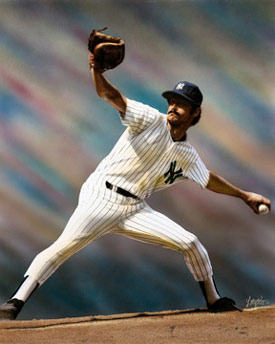 SI's Jim Kaplan was prophetic - or at least 67% prophetic. Tony Perez and Ozzie Smith have indeed been inducted into the cherished Hall. Ron Guidry, however...
I highly recommend the article. Kaplan succinctly stated the case for Perez, Guidry and Smith, and also neatly summarized the rather narrow perspective of the typical BBWAA voter. Click here to read the whole article.
There is a very telling quote in Kaplan's article from Ray Miller, the manager of the Twins at the time and former Oriole pitching coach.
"Ron definitely deserves to be in the Hall. He throws strikes and has great leverage when he comes over the top. And he's one of the best fielding pitchers I've ever seen. Sure, his fastball isn't what it used to be, but he throws two different sliders and mixes in curves and change-ups. The only problem with Guidry is that he doesn't talk up his own case."Indeed, Guidry does not talk up his own case. It's just not Guidry's nature to tout himself. I fear the accomplishments of the Quiet Cajun have been overshadowed by the legends and myths surrounding the outsized personalities in the Bronx Zoo - Steinbrenner, Jackson and Martin. A few more trips to the SI archives might help remind the Veterans Committee of how highly Guidry was regarded in his time.
